

Military Specifications Guide.
- Jump to:
Understanding Military Specifications
Military specifications (MIL-SPEC) define the technical requirements for materials, products, and processes used in defense and aerospace applications. These standards ensure consistent quality, performance, and reliability across all certified suppliers.
At Aerospace Metals, our integrated production cells are fully qualified to process components according to the most demanding military and aerospace specifications. We provide complete documentation and rigorous traceability for all MIL-SPEC work.
ITAR Registered
Nadcap Accredited
Full Documentation

Anodizing Specifications .
Anodic Coatings for Aluminum
- Type I - Chromic Acid
- Type II - Sulfuric Acid
- Type III - Hardcoat
Hard Anodic Coating
- Type III Class 1 & 2
Anodic Coating - Chromic Acid
- Type I Process
Anodic Coating - Sulfuric Acid
- Type II Class 1 & 2
Plating Specifications.
Cadmium Plating
QQ-P-416
- Type I, II, III
- Classes 1, 2, 3
Zinc Plating on Iron and Steel
ASTM B633
- Type I-IV
- Classes Fe/Zn
Electroless Nickel Plating
MIL-C-26074
- Class 1, 2, 3, 4
Electroless Nickel Plating
AMS 2404
- Low Phosphorus
Nickel Plating
QQ-N-290
- Class 1, 2
Chrome Plating - Hard
QQ-C-320
- Class 1, 2, 2a
Chrome Plating - Surface Prep
MIL-DTL-5002
- Type I, II
Chemical Conversion & Passivation.
Chemical Conversion Coatings (Alodine)
MIL-DTL-5541
- Class 1A, 3
Chemical Conversion Materials
MIL-DTL-81706
- Class 1A, 3
Passivation of Stainless Steel
ASTM A967
- Nitric Acid, Citric Acid
Passivation Treatments
AMS 2700
- Method 1, 2, 3, 4
Phosphate Coating - Heavy
MIL-DTL-16232
- Type M, Z
Primers & Specialty Coatings .
Primer - Epoxy
MIL-PRF-23377
- Type I, II
Polyurethane Coating
MIL-PRF-85285
- Type I
Dry Film Lubricant
AMS-C-27725
- Type I, II
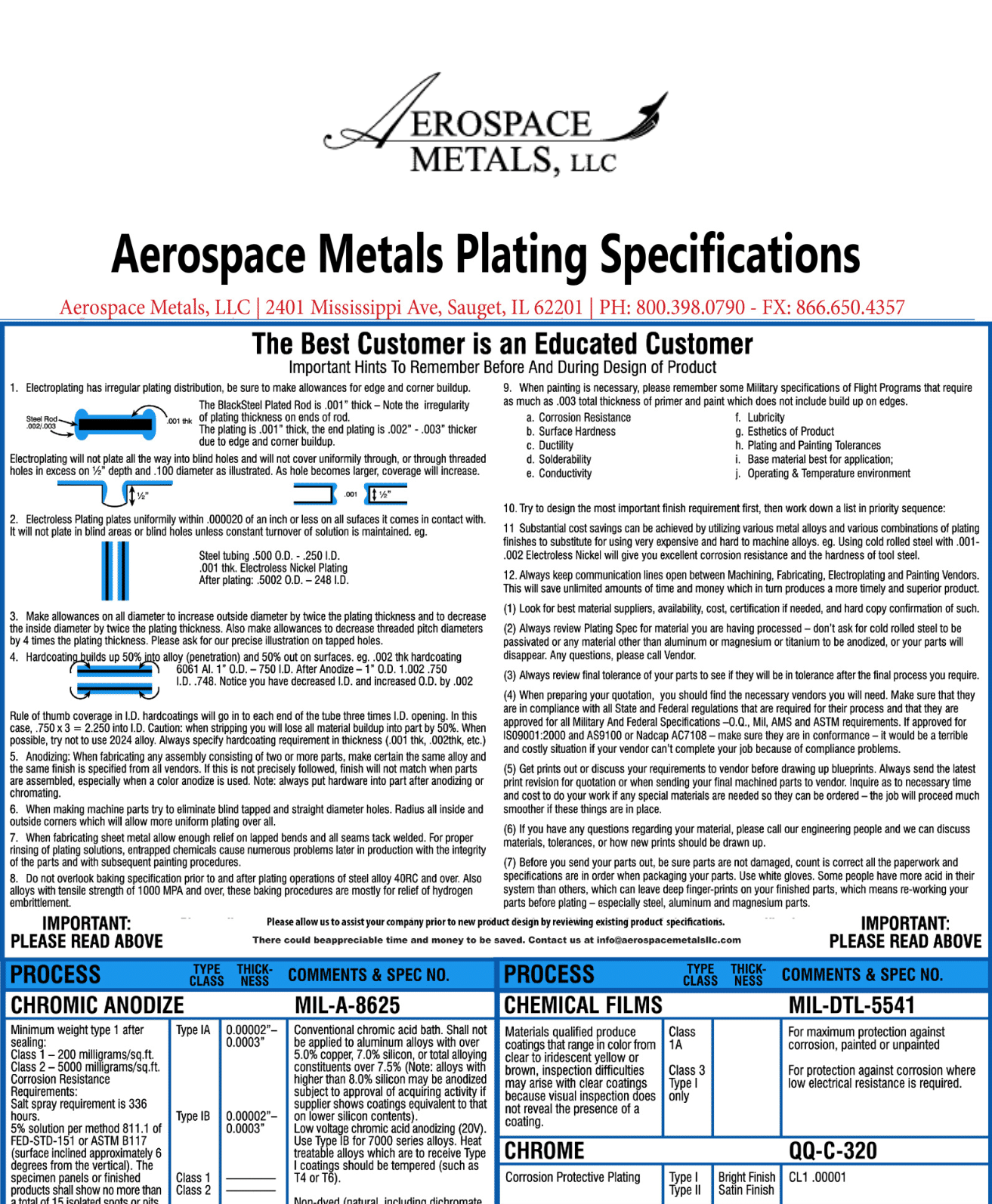
Complete Plating Specifications Guide
Get our comprehensive PDF reference guide with complete MIL-SPEC plating and finishing specifications. Perfect for engineers, procurement specialists, and quality teams.
- Complete anodizing, plating, and coating specs
- Thickness tolerances and class designations
- Material compatibility guidelines
- Process selection recommendations