

Professional Metal Finishing Services.
Complete Surface Finishing Solutions
Certified Quality
Fast Turnaround
Full Documentation
Expert Guidance
Anodizing for Aluminum
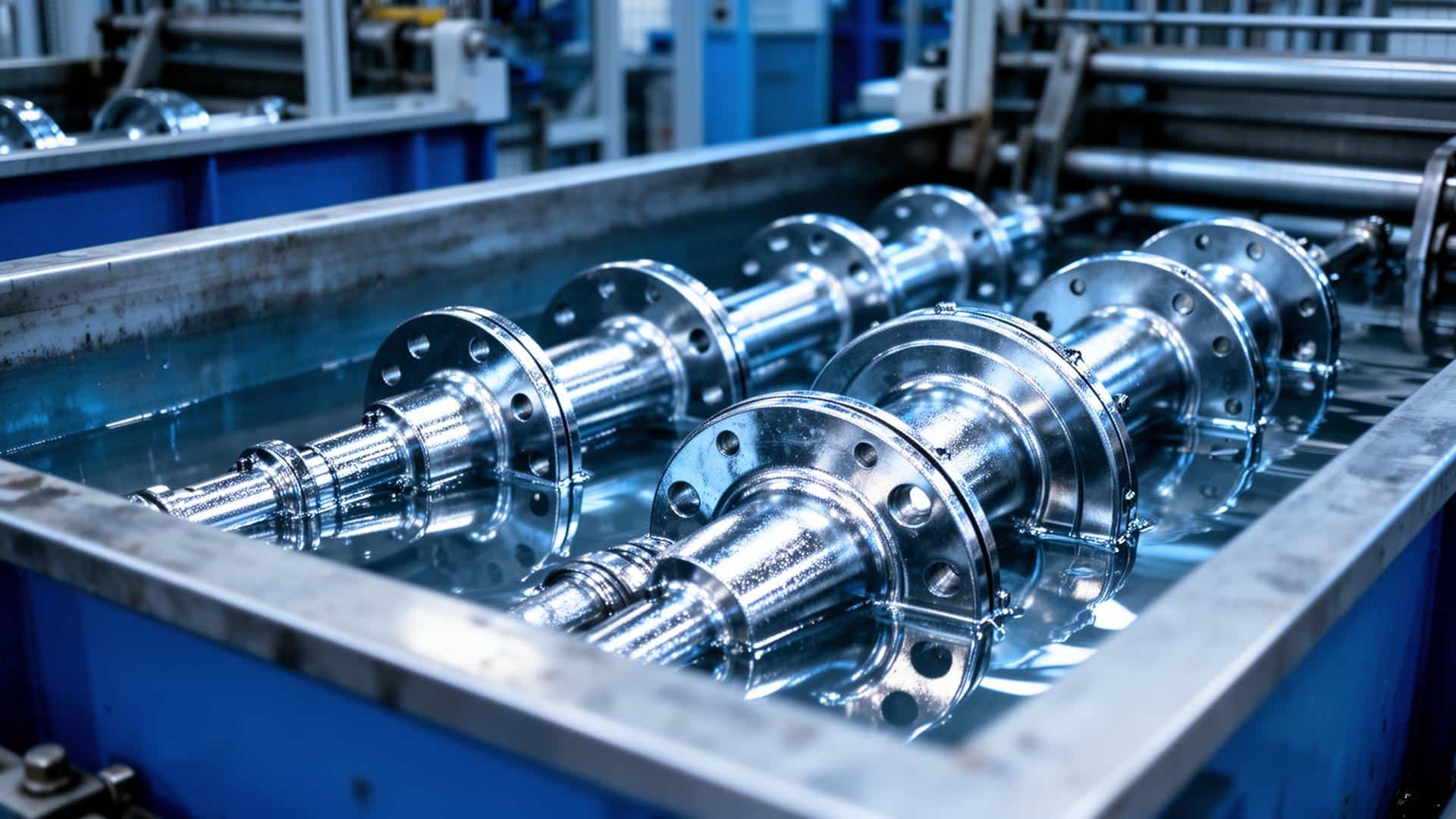
Anodizing is an electrochemical process that converts the surface of aluminum into a durable, corrosion-resistant oxide layer. Unlike paint or plating, anodizing is part of the metal itself.
Type I - Chromic Acid Anodizing
- Excellent for tight-tolerance parts
- Superior paint adhesion base
- Common in aerospace applications
- Meets MIL-A-8625 Type I
Type II - Sulfuric Acid Anodizing (Standard)
- Available in clear or dyed colors
- Good corrosion and wear resistance
- Cost-effective for most applications
- Meets MIL-A-8625 Type II
Type III - Hardcoat Anodizing
- Exceptional wear and abrasion resistance
- Exceptional wear and abrasion resistance
- Available in black or natural
- Meets MIL-A-8625 Type III
Bright Dip Anodizing
- Pre-treatment for decorative applications
- Automotive and consumer products
- Creates highly polished surface
Electroplating Solutions.
Cadmium Plating
Superior corrosion protection, aerospace/military standard, excellent sacrificial protection
Zinc & Zinc-Nickel Plating
Cost-effective corrosion resistance, RoHS-compliant alternative to cadmium
Electroless Nickel Plating
Uniform coating on complex geometries, excellent wear and corrosion resistance
Copper Plating
Excellent electrical conductivity, undercoat for other platings, heat dissipation
Tin & Silver Plating
Food-grade safe finishes, excellent solderability, electrical applications
Chrome Plating (Decorative & Hard)
Decorative mirror-like appearance or extreme wear resistance for industrial use
Protective & Decorative Coatings
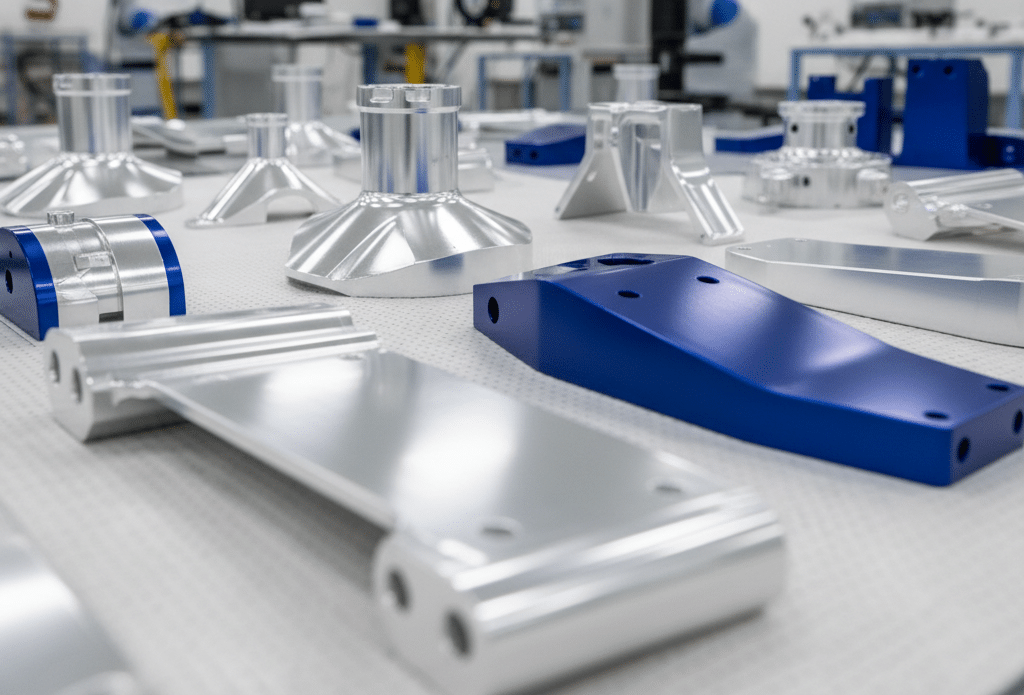
From powder coating to e-coating and chemical film treatments, we coordinate all your coating needs through certified partner facilities with documented quality systems.
Powder Coating
Dry powder finish electrostatically applied and heat-cured for durable, attractive coating.
- Thick, durable finish
- Wide color selection (RAL, Pantone)
- Environmentally friendly (no VOCs)
- UV resistant
E-Coating (Electrocoating)
Electrodeposition of paint for uniform, corrosion-resistant finish on complex geometries.
- Exceptional coverage on complex parts
- Superior corrosion protection
- Automotive-grade durability
Chemical Film (Alodine/Chromate)
Thin chemical conversion coating for aluminum providing corrosion resistance and paint adhesion.
- Exceptional wear and abrasion resistance
- Exceptional wear and abrasion resistance
- Available in black or natural
- Meets MIL-A-8625 Type III
Black Oxide
Chemical conversion coating for steel providing mild corrosion resistance and aesthetic black finish.
- Minimal dimensional change
- Improves lubricity with oil
- Cost-effective
Ready to Order Materials? .
FAQs
What is the difference between Type II and Type III anodizing?
Type II (sulfuric acid anodizing) is the standard commercial process used for corrosion resistance and aesthetics, producing a thinner coating. Type III (hardcoat anodizing), a specialty of Aerospace Metals, creates a much thicker (0.001"–0.004"), denser coating designed for extreme wear resistance and electrical insulation in industrial applications.
Can Aerospace Metals match specific colors for anodized parts?
Yes. We offer a wide range of standard colors including black, blue, red, gold, and clear. While anodizing is a chemical process susceptible to slight alloy variations, our production oversight team ensures strict lot-to-lot consistency across all manufacturing cells. For branding, please provide a Pantone reference.
Do you offer Nadcap-accredited finishing services?
Absolutely. We specialize in managing Nadcap-accredited finishing operations for aerospace and defense projects. When requesting a quote, simply specify that your project requires Nadcap certification, and we will process your job through the appropriate certified production cell within our network.
What is chem film (Alodine) and when should I use it?
Chemical film (Alodine/Chromate) is a conductive surface treatment for aluminum that provides corrosion protection. Aerospace Metals recommends it for parts requiring electrical grounding or as a primer base for paint, as it does not add significant thickness to the part dimensions.
Can Aerospace Metals plate parts that are already machined?
Yes, we frequently plate precision-machined components. Many customers utilize Aerospace Metals as a single-source solution for both machining and plating to ensure accountability. We account for the plating thickness in the final dimensions to ensure your finished part meets tolerance specifications.
What is the advantage of electroless nickel plating?
Electroless nickel plating deposits a uniform thickness of nickel-phosphorus alloy without using electrical current. Aerospace Metals recommends this for complex shapes, internal bores, and threads, as it ensures even coverage where traditional electroplating might be uneven.
How do you handle delicate or precision parts during finishing?
We understand that surface finish and dimensional integrity are critical. Aerospace Metals ensures that parts are processed using specialized racking and handling procedures to prevent contact damage. We can also implement custom masking plans to protect critical surfaces.
Do you offer passivation for stainless steel?
Yes. We offer precision passivation for stainless steel components to remove free iron and enhance the passive oxide layer. We operate under strict quality controls to meet ASTM A967, AMS 2700, and other rigorous industry standards.