

Laser Cutting .
- Quick Specifications
Lead Time
3-7 business days
Certifications
ISO 9001
Compatible Materials
Steel, Stainless Steel, Aluminum, Brass, Copper, Titanium
Industries
Aerospace, Medical, Electronics, Industrial Equipment, Automotive
Laser Cutting
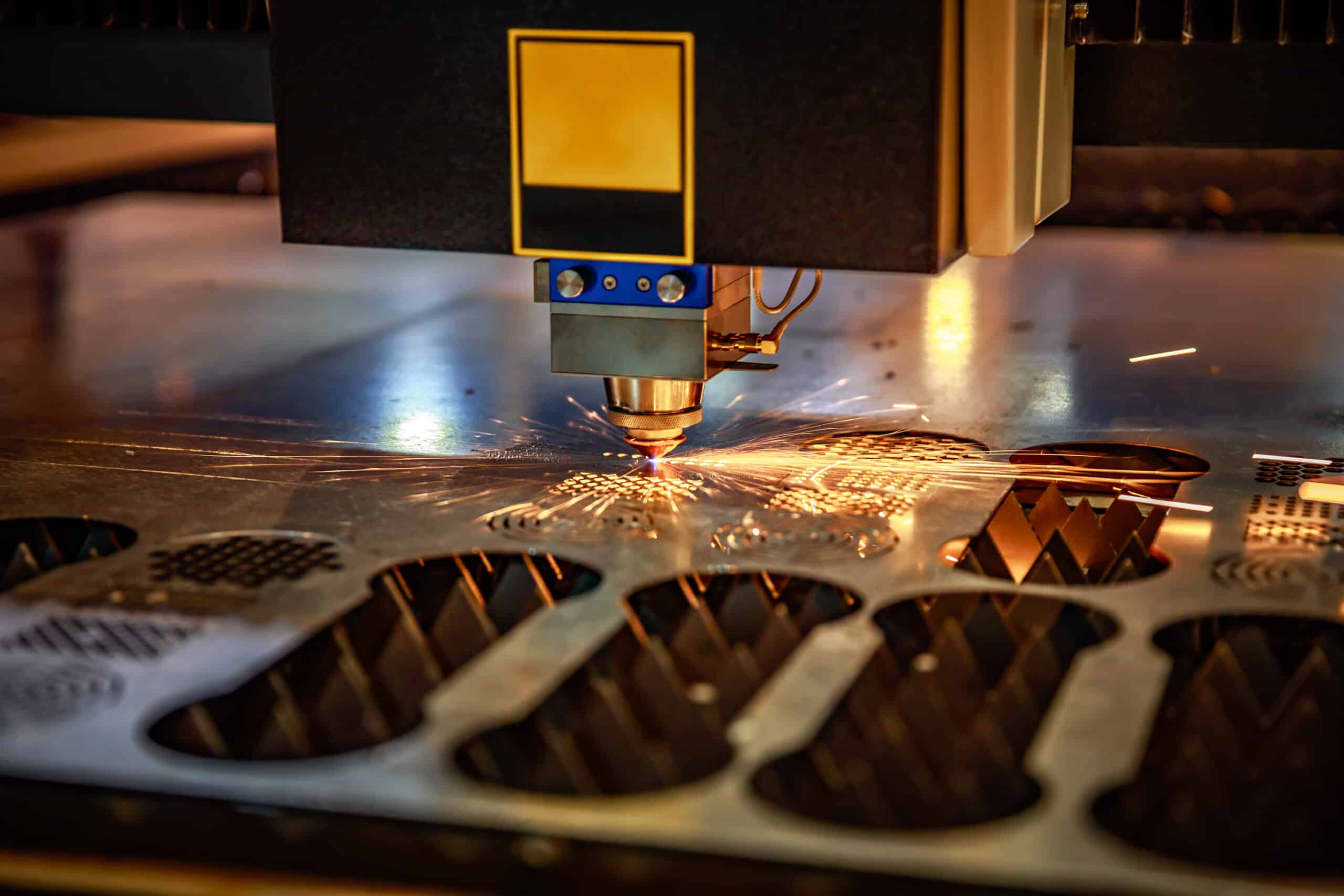
Fiber and CO2 laser cutting provides exceptional precision for cutting complex shapes in sheet metal with minimal heat-affected zones. The process delivers clean edges requiring little to no secondary finishing and maintains tight tolerances across large production runs.
Our integrated production cells utilize high-power fiber and CO2 lasers capable of cutting thick materials with exceptional speed and precision. This setup makes laser cutting ideal for everything from rapid prototypes to high-volume production runs.
- Precision cutting
- Complex shapes
- Minimal HAZ
- Clean edges

How Laser Cutting Works.
File Preparation
Your DXF/DWG files are optimized for cutting. Nesting maximizes material utilization.
Material Setup
Material loaded, settings optimized for your specific material type and thickness.
Laser Cutting
High-precision fiber or CO2 laser cutting with minimal heat-affected zone.
Deburring
Edge finishing removes any minor burrs for clean, ready-to-use parts.
Quality Check
Dimensional verification against your specifications before packaging.
Laser Cutting Solutions Across Industries
Aerospace & Aviation
Industrial Equipment
Medical Services
Automotive
Electronics

Available Certifications Across Our Production Cells
ISO 9001:2015
AS9100 Rev D
Technical Specifications
Compatible Materials
Aluminum
Titanium
Brass
Stainless Steel
Steel
Copper
Available Processes
Fiber Laser
CO2 Laser
Tube Laser
Flat Sheet
Frequently Asked Questions
What materials can you laser cut?
Our laser cutting cells can process a wide variety of metals including carbon steel, stainless steel, aluminum, titanium, brass, and copper alloys. We also have capabilities for cutting certain plastics and composite materials.
What is the maximum material thickness you can laser cut?
Thickness capabilities depend on the specific material and the type of laser used. Generally, our high-power fiber lasers can cut carbon steel up to 1 inch thick, stainless steel up to 0.75 inches, and aluminum up to 0.5 inches.
What tolerances can you hold with laser cutting?
We typically hold tolerances of plus or minus 0.005 inches on most sheet metal profiles. Tighter tolerances can often be achieved depending on the material thickness and part geometry.
What is the difference between Fiber and CO2 lasers?
Fiber lasers are highly efficient and excel at cutting thin to medium metals very quickly, especially reflective materials like aluminum and copper. CO2 lasers generally provide a smoother edge finish on thicker materials and are better suited for cutting non-metals like plastics and wood.
Can you cut tubing and structural shapes?
Yes. In addition to flat sheet lasers, our operations include specialized tube laser cutting equipment capable of precisely processing round, square, rectangular, and custom profile tubing.
Do laser cut parts require secondary finishing?
Modern laser cutting produces very clean edges with minimal dross. However, some applications may require edge breaking or deburring. We offer complete mechanical finishing services in-house to ensure your parts are ready for use or subsequent coating.
Do you handle post-cutting metal finishing?
Absolutely. As a fully integrated manufacturer, we can route your laser cut components directly into our plating, anodizing, or painting cells, saving you the time and logistical hassle of managing multiple vendors.
What file formats do you need to provide a quote?
For laser cutting, flat 2D vector files such as DXF or DWG formats are preferred. We also accept 3D models (STEP, IGES, SolidWorks) which our engineering team can flatten and optimize for cutting.