

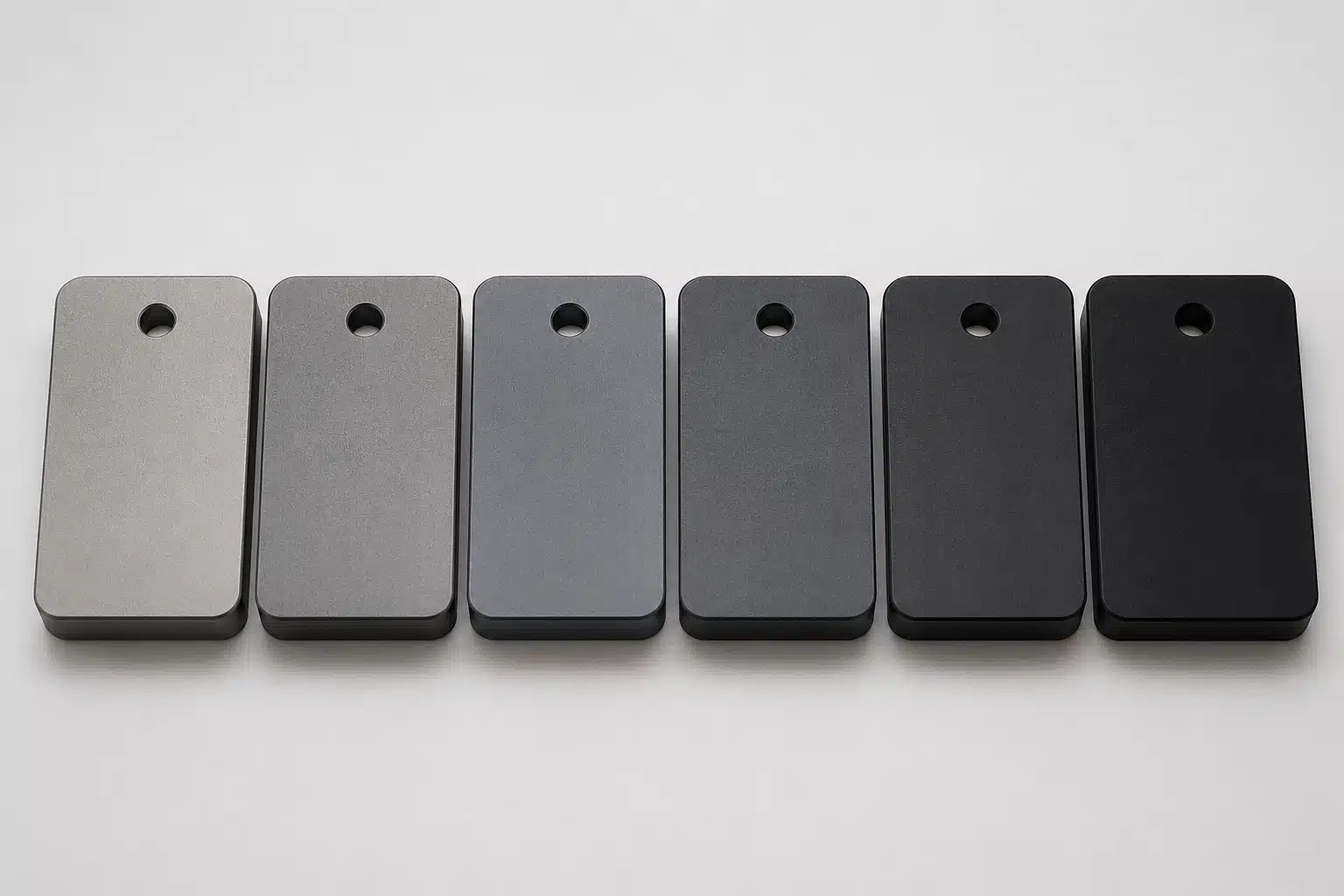
One of the most common questions we receive from customers is:
“Why don’t all of my hard coat anodized parts match exactly, even though they are made from the same aluminum alloy?”
It’s a fair question, but the answer lies in the science of the hard coat anodizing process.
Hard Coat Anodizing Is a Protective Coating, Not a Decorative Finish
Hard coat anodizing performed to MIL-PRF-8625 Type III Class 1 is designed to produce a dense, wear-resistant aluminum oxide layer that provides exceptional abrasion resistance, corrosion protection, and durability. The specification is focused on performance—not cosmetic appearance.
Unlike paint or powder coating, anodizing does not add color to the surface. Instead, it converts the aluminum itself into aluminum oxide. The natural appearance of that oxide layer can vary from light gray to dark charcoal depending on numerous processing variables.
Why Parts Made From the Same Alloy Can Look Different
Even when every part is manufactured from the same aluminum alloy and processed in the same production run, slight color differences can occur. Several factors contribute to these natural variations.
1. Minor Differences in Alloy Chemistry
Although parts may all be certified as the same alloy, each production lot falls within an allowable chemical composition range. Small variations in elements such as silicon, magnesium, copper, iron, or manganese can influence how the oxide layer forms and how it reflects light.
2. Material Grain Structure
Differences in grain size, extrusion direction, forging, casting, or heat treatment affect how the anodic coating develops. Two pieces of 6061 aluminum can have slightly different metallurgical structures even though both meet the same alloy specification.
3. Surface Finish Before Anodizing
Anodizing enhances whatever surface already exists. Parts that have been machined with different cutters, polished differently, bead blasted, vibratory finished, or handled differently before processing will often produce different visual appearances after anodizing.
4. Hard Coat Thickness
MIL-PRF-8625 specifies coating thickness requirements, but even within specification, slight differences in oxide thickness can influence the shade of the finished part. Thicker coatings often appear darker than thinner coatings.
5. Part Geometry
Sharp corners, deep pockets, varying wall thicknesses, and changes in current density across the part all affect coating growth. Larger, heavier sections may dissipate heat differently than thin sections, resulting in subtle appearance differences.
6. Process Variables
Hard coat anodizing is performed at very low temperatures and high current densities. Small changes in electrolyte temperature, acid concentration, current distribution, agitation, and rack contact can slightly alter the appearance of the oxide layer while still producing a coating that fully meets the military specification.
The Human Eye Is Extremely Sensitive
Ironically, the color differences are often more noticeable when parts are placed directly next to one another under bright lighting. Individually, each part may appear perfectly normal. Side-by-side comparison makes even minor differences stand out.
Performance Should Always Be the Primary Acceptance Criteria
MIL-PRF-8625 Type III Class 1 exists to ensure the coating provides the required hardness, wear resistance, corrosion protection, and dimensional performance. The specification does not require perfect cosmetic color matching because achieving identical appearance on every aluminum component is not technically practical.
Customers should evaluate hard coat anodized parts primarily on whether they meet the required engineering and performance specifications rather than expecting an exact cosmetic match.
Working Toward the Best Possible Consistency
At Aerospace Metals, we carefully control every aspect of our hard coat anodizing process, including bath chemistry, operating temperature, current density, processing time, and quality inspections. We also process matching components together whenever practical to maximize consistency.
Even with these controls, slight shade variations are a normal characteristic of hard coat anodizing and should be expected on high-performance coatings produced to MIL-PRF-8625 Type III Class 1.
Understanding these natural variations helps set realistic expectations while ensuring the most important objective is achieved—a durable, high-performance coating that delivers years of reliable service in demanding environments.