

CNC Turning Service.
- Quick Specifications
Lead Time
7-10 business days
Certifications
ISO 13485
Swiss-Type Turning
Swiss-type turning (Swiss screw machining) is designed for small, complex parts requiring extreme precision. The sliding headstock design supports the workpiece close to the cutting tool, enabling exceptional accuracy and surface finish on long, slender parts.
This process excels at high-volume production of precision components like pins, shafts, connectors, and medical implant components. Our advanced turning cells routinely maintain tolerances to ±0.0001″ with surface finishes down to 8 Ra.
- Extreme precision
- Complex small parts
- High-volume capability
- Excellent surface finish
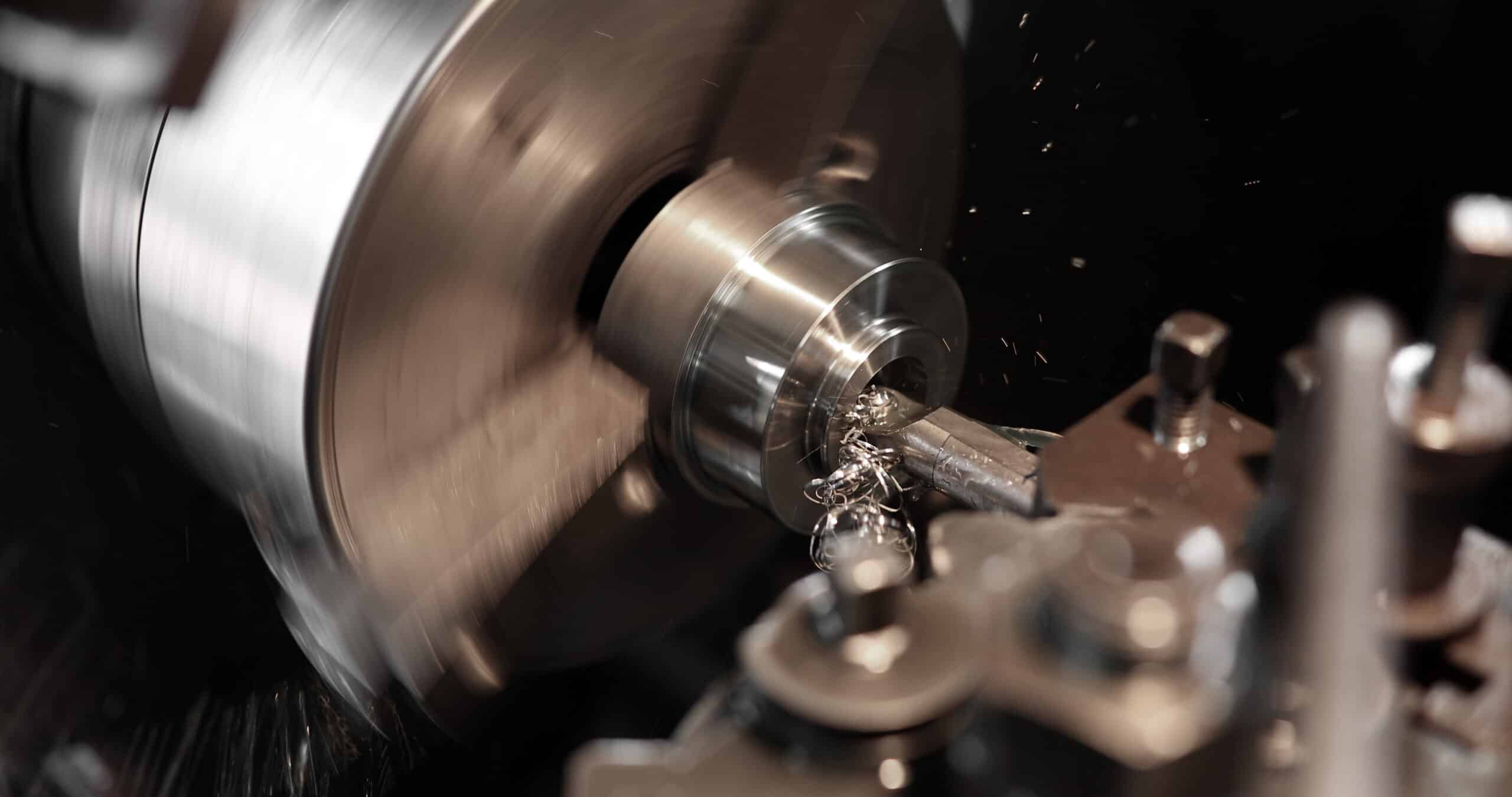

How Swiss-Type Turning Works.
Design Review
Engineers review your files for manufacturability and optimization opportunities.
Programming
CNC programs developed with optimized toolpaths for efficiency and quality.
Machining
Precision CNC machining with in-process monitoring and verification.
Inspection
Dimensional verification using CMM and precision measuring instruments.
Delivery
Parts finished, documented, and delivered to your specifications.
5-Axis CNC Milling Solutions Across Industries
Aerospace & Aviation
Defense
Medical Services
Electronics

Available Certifications Across Our Production Cells
ISO 9001:2015
AS9100 Rev D
ISO 13485
FDA Registered
Technical Specifications
Compatible Materials
Aluminum
Titanium
Brass
Stainless Steel
PEEK
Medical Alloys
Available Processes
Multi-Spindle
Live Tooling
Back-Working
Sub-Spindle Operations
Frequently Asked Questions
What is Swiss-type CNC turning?
Swiss-type turning, or Swiss machining, utilizes a sliding headstock and a guide bushing to support the workpiece extremely close to the cutting tool. This design minimizes deflection and vibration, allowing for the precise machining of very long, slender, and complex parts.
What materials can your CNC turning cells process?
Our turning operations process a wide spectrum of materials including aerospace aluminum, titanium, stainless steel, brass, copper alloys, tool steel, and engineered plastics.
What tolerances can you hold on turned parts?
Thanks to our advanced Swiss-type lathes, we can consistently hold tolerances as tight as plus or minus 0.0001 inches, depending on the material and specific part geometry.
Do you offer live tooling and multi-axis turning?
Yes. Our CNC turning centers feature live tooling, sub-spindles, and Y-axis capabilities. This allows us to perform milling, drilling, and tapping operations on the lathe, allowing complex parts to be completed in a single setup.
What is your typical production volume for turned parts?
Our automated turning cells are optimized for everything from medium volume production runs (hundreds of parts) to high volume continuous manufacturing (tens of thousands of parts). We also accommodate short-run prototyping.
Can you handle post-machining surface treatments?
Absolutely. As a fully integrated manufacturer, we seamlessly route your turned components directly into our finishing cells for anodizing, passivation, plating, or painting without the delays of shipping to outside vendors.
Are your turning operations certified for aerospace and medical components?
Yes. Our machining operations maintain ISO 9001:2015, AS9100 Rev D, and ISO 13485 certifications, ensuring we meet the stringent quality requirements of the aerospace, defense, and medical device industries.
What file formats do you need to provide a quote?
We accept most standard CAD formats including STEP, IGES, SolidWorks, and PDF drawings. Providing a 3D model alongside a 2D drawing with specific tolerances and finish requirements allows for the most accurate quote.