

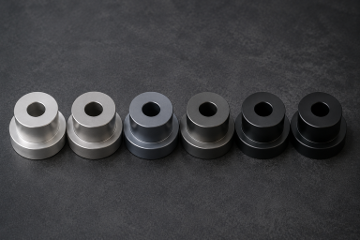
Different aluminum alloys can look noticeably different after anodizing because anodizing does not create the final appearance by itself. The chemistry and metallurgical structure of the aluminum strongly influence the appearance of the anodized surface.
Why Do Different Aluminum Alloys Look Different After Anodizing?
When aluminum is anodized, the surface of the aluminum is converted into a porous aluminum oxide coating. However, the aluminum underneath the coating is not chemically pure. Different aluminum alloys contain different amounts of elements such as silicon, copper, magnesium, manganese, zinc, and iron.
These alloying elements affect the anodizing process and the appearance of the finished part in several ways.
1. Different Alloying Elements React Differently
During anodizing, aluminum is converted into aluminum oxide while the surface is simultaneously exposed to an acidic electrolyte. The various alloying elements do not behave the same way as aluminum.
Some dissolve into the electrolyte, while others can remain as microscopic particles or compounds within the aluminum or near the surface.
This can affect the final:
- Color
- Brightness
- Grayness
- Reflectivity
- Uniformity
- Surface appearance
2. Intermetallic Compounds Affect Appearance
Alloying elements form microscopic compounds and particles within the aluminum. These are often referred to as intermetallic phases.
During anodizing, these particles can react differently from the surrounding aluminum. Some may dissolve, while others remain in or near the anodized surface.
The result can be differences in light reflection and absorption, which can make one alloy appear brighter, darker, grayer, or more mottled than another.
3. Different Alloys Produce Different Colors
Two aluminum alloys can be processed using exactly the same anodizing parameters and still produce noticeably different colors.
For example, 6061 and 6063 aluminum can both be clear anodized, yet 6063 will generally produce a brighter and more uniform appearance than 6061.
This is one reason 6063 is widely used for applications where cosmetic appearance is important.
Other alloys, such as 2024, 7075, and various cast aluminum alloys, can produce substantially different appearances after anodizing.
4. Surface Reflectivity Is Different
The alloy’s chemistry, grain structure, heat treatment, and manufacturing history can all influence the condition of the aluminum surface before anodizing.
Since anodizing follows the existing surface rather than covering it like paint, differences in the underlying metal can affect how light is reflected from the finished anodized surface.
A highly polished surface, for example, will generally appear very different after anodizing than a rougher machined or cast surface.
5. Dye Absorption Can Vary
With Type II dyed anodizing, the anodized coating contains microscopic pores that absorb dye.
The characteristics of the oxide layer can vary depending on the aluminum alloy and the anodizing conditions. As a result, the same dye and the same process can produce different shades on different aluminum alloys.
This is one reason why achieving an exact cosmetic color match between different aluminum alloys can be difficult.
6. Heat Treatment and Manufacturing History Matter
Even two parts made from the same aluminum alloy can sometimes anodize differently.
Differences in:
- Temper
- Heat treatment
- Grain structure
- Machining
- Surface finish
- Forging or casting history
- Material chemistry within the allowable alloy range
can influence the final appearance.
In other words, specifying only the alloy does not always guarantee that two parts will look exactly the same after anodizing.
Do Different Aluminum Alloys Have to Be Anodized in Separate Baths?
Not necessarily.
Different aluminum alloys can often be processed in the same anodizing bath. However, when appearance, color consistency, or tight cosmetic requirements are important, different alloys may need to be processed separately or under different process conditions.
An anodizer must control variables such as:
- Anodizing current density
- Voltage
- Bath temperature
- Acid concentration
- Dissolved aluminum
- Anodizing time
- Dye concentration and temperature
- Sealing conditions
Different alloys can respond differently to these variables.
Consequently, a process optimized for one alloy may not produce the same appearance on another alloy.
Cast Aluminum Can Be Particularly Challenging
Cast aluminum alloys can be especially difficult to anodize consistently because their chemistry and microstructure can be substantially different from wrought alloys.
For example, some cast alloys contain relatively high amounts of silicon. Silicon does not anodize in the same manner as the aluminum matrix and can remain in the surface as particles or phases.
This can result in a darker, grayer, or less uniform appearance.
Alloys containing significant amounts of copper can also behave differently during anodizing and may produce a different appearance than lower-copper alloys.
Why This Is Especially Important With Type III Hardcoat
The differences between aluminum alloys can become particularly noticeable with Type III hardcoat anodizing per MIL-PRF-8625.
For example, a 6061 aluminum part and a cast aluminum part can both receive a .002-inch Type III hardcoat and both meet the applicable specification, yet the two parts may have noticeably different colors or surface appearances.
Changing the anodizing temperature, current density, or processing time can influence the appearance, but process adjustments cannot completely eliminate the fundamental differences caused by the metallurgy of the aluminum.
Therefore, it is generally not realistic to guarantee an exact cosmetic color match between substantially different aluminum alloys, even when the parts receive the same anodizing specification, coating thickness, and processing parameters.
Anodizing Is Not Paint
This is one of the most important concepts to understand about anodizing:
Anodizing is a conversion coating—not paint.
Paint puts a separate colored material over the surface of the metal. Anodizing, on the other hand, converts the aluminum surface itself into an aluminum oxide coating.
Because the coating is created from the aluminum substrate, the chemistry and metallurgical characteristics of the aluminum become part of the finished appearance.
That is why two different aluminum alloys can receive the same anodizing process and still produce different colors and finishes.
The Bottom Line
When different aluminum alloys are anodized, the anodizing process is only part of the equation.
The final appearance is influenced by:
Aluminum alloy + alloy chemistry + microstructure + surface condition + anodizing process = final appearance
This is why a 6061 part, a 6063 part, and a cast aluminum part can all be anodized to the same MIL-PRF-8625 requirements and still look significantly different.
For applications where multiple parts must have a consistent cosmetic appearance, it is important to identify the exact aluminum alloy and material condition before anodizing and, whenever possible, use the same alloy and similar material sources throughout the project.
About Aerospace Metals
Aerospace Metals LLC specializes in Bright Dip Anodizing, Type II Anodizing, Type III Hardcoat Anodizing, Plating, Chromate Conversion Coating, CNC Machining, Metal Fabrication, and Painting.
For more information, visit www.aerospacemetalsllc.com.