

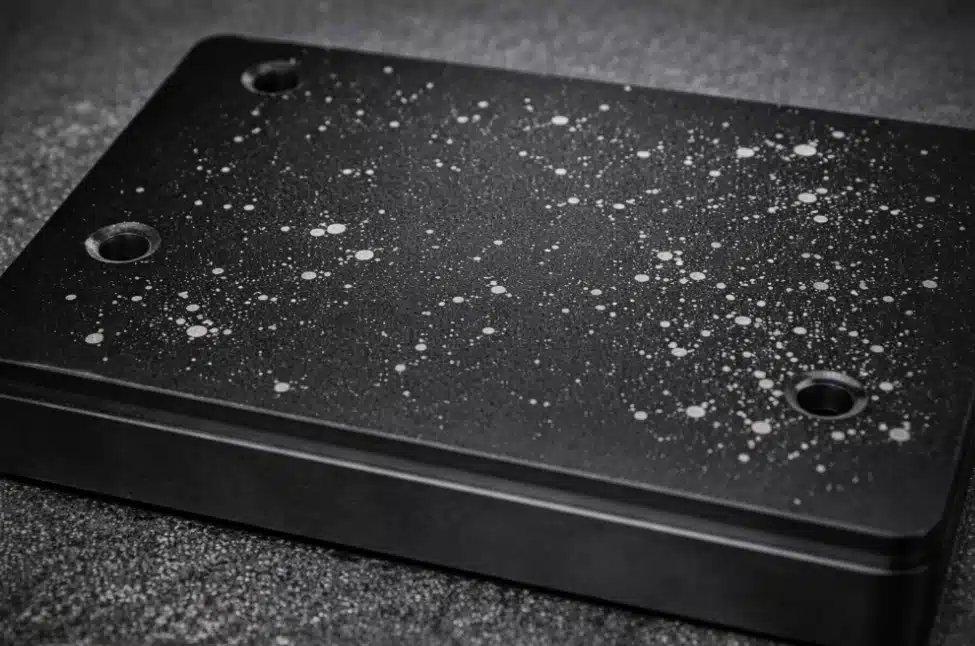
When customers request black anodizing, they’re often expecting a smooth, uniform, jet-black finish. But in some cases—especially when working with cast aluminum tooling plate like ALCA5—small white or light gray spots can appear on the surface.
At Aerospace Metals, this is one of the most common questions we receive. The short answer: these spots are typically caused by the material itself—not a defect in the anodizing process.
Let’s break down why this happens.
The Primary Cause: Silicon Content in Cast Aluminum
ALCA5 (and similar cast tooling plates like MIC-6) contain higher levels of silicon compared to wrought alloys such as 6061-T6.
During anodizing:
- Aluminum converts to an oxide layer that readily absorbs dye
- Silicon does not anodize or absorb dye in the same way
As a result:
- Silicon-rich areas remain lighter in color
- These show up as white or gray speckling, especially noticeable in black anodize
This is the #1 cause of white spotting.
Porosity in Cast Tooling Plate
Another contributing factor is the inherent porosity of cast aluminum.
- Cast materials can contain microscopic voids or trapped gases
- During anodizing, these areas can trap solution or resist dye penetration
The result:
- Uneven dye absorption
- A “freckled” or spotted appearance across the surface
Surface Inclusions and Contamination
In some cases, white spots can be linked to:
- Embedded oxides or impurities in the material
- Incomplete removal of surface smut during pre-treatment
If these areas aren’t fully cleaned during the etch and desmut process, they can:
- Resist anodizing and dye uptake
- Appear as visible white defects after finishing
The Role of Pre-Treatment and Processing
While material is the primary driver, processing still plays a role.
For cast aluminum, anodizers often need:
- More aggressive etching
- Double desmut cycles (commonly nitric acid + ammonium bifluoride)
If pre-treatment is insufficient:
- Silicon may not be properly addressed
- Coating and dye absorption can become inconsistent
Thickness and Sealing Variations
Additional variables include:
- Thin anodic coatings, which absorb less dye
- Inconsistent sealing, which can make cosmetic variations more visible
These factors don’t typically cause spotting on their own—but they can amplify what’s already present in the material.
Important Expectation: Material Matters
It’s critical to understand:
Cast aluminum will never anodize as uniformly as wrought aluminum.
Even with a perfect anodizing process:
- Some level of variation or speckling is normal
- Black anodize makes these differences more visible due to high contrast
How to Minimize White Spotting
While you can’t fully eliminate the issue, you can reduce it:
- Specify enhanced pre-treatment (etch + double desmut)
- Set clear cosmetic expectations with your supplier
- Communicate that cast aluminum variation is acceptable
When Appearance Is Critical
If a clean, cosmetic black finish is required, material selection becomes key.
We typically recommend:
- 6061-T6 aluminum → much more uniform anodize appearance
- Avoid cast plates like ALCA5 or MIC-6 for cosmetic applications
These materials are excellent for:
- Dimensional stability
- Machinability
…but are best suited for functional—not cosmetic—components.
Bottom Line
White spots on black anodized ALCA5 are most often caused by:
- Silicon content
- Material porosity
—not a failure in processing.
Understanding this upfront helps set the right expectations, avoid unnecessary rework, and ensure the right material is selected for the job.